To budget audio post-production in Austin in 2026, get a written quote tied to your recording length, editing scope, and final deliverables. Separate recording from post-production, and confirm whether the quote includes revisions, audio repair, and video work. Compare the work included, not just the total quoted.
- For audio post-production cost Austin comparisons, request identical editing scopes before comparing quotes.
- Justpushrecord suits podcast hosts who want one-button, three-camera recording without a crew.
- Separate dialogue editing, sound cleanup, mixing, and video deliverables in your brief.
- Confirm revision limits and final file requirements before approving post-production.
Why this matters
A finished podcast episode involves decisions that a recording session does not resolve. Someone still needs to decide what stays, what gets cut, how voices sound together, and which files are ready to publish.
Justpushrecord provides automated podcast studio recording and Google Drive file delivery. That describes the recording workflow; confirm editing deliverables separately before treating a studio booking as a complete production package.
For your 2026 budget, keep recording, editing, and publishing as separate lines. Combine them only when a written proposal explicitly includes each service. This keeps an attractive recording quote from becoming your assumed end-to-end budget.
How much does audio post-production cost in Austin?
Your usable budget is the quote for your actual episode, not an hourly figure without a scope. Ask each Austin provider to quote the same source material and the same finished result.
An hourly quote needs an estimated workload. A per-episode quote needs boundaries around recording length, content changes, revisions, and exports. Neither format tells you enough on its own.
Use this breakdown to make the work visible:
| Workstream | What to specify | What to confirm before approval |
|---|---|---|
| Dialogue editing | Mistakes, pauses, repetitions, and unwanted sections | Whether the editor follows timestamps or makes editorial decisions |
| Audio cleanup | Background noise, clicks, hum, and inconsistent recordings | Which problems the editor will address and which remain |
| Mixing | Voice balance, music placement, and overall consistency | Whether all speakers and supplied music are included |
| Final mastering | Delivery loudness and final quality checks | The intended publishing destination and export requirements |
| Revisions | Changes after you review the first edit | Included revision scope and how new requests are handled |
| Additional deliverables | Video, clips, alternate versions, or separate files | Which outputs are included and which require separate work |
Ask for these items in writing before approving the project. You do not need a complicated production document. You need enough detail to tell whether two proposals describe the same job.
For example, removing a mistaken introduction is a specific instruction. Asking an editor to make an interview more engaging requires editorial judgment. Those are different assignments, even when they start with the same recording.
Dialogue editing: best for a clear conversation that needs tightening
Dialogue editing addresses what the listener hears and when they hear it. You specify unwanted sections, repeated answers, long pauses, false starts, and any material that must remain untouched.
Best for: hosts who have a usable conversation and want a focused episode without changing its meaning.
The benefit is control over pacing and content. The limitation is that dialogue editing does not automatically include difficult noise repair, music production, or video editing. Put those tasks in the brief if you need them.
Tell the editor how natural you want the conversation to sound. Removing every hesitation is a different instruction from removing only distracting interruptions. For interviews, identify any answers that need approval before cuts change their context.
Audio cleanup and mixing: best for distracting sound problems
Cleanup targets unwanted sounds. Mixing balances the wanted sounds, including voices and any supplied music. Ask the provider to distinguish these tasks rather than describe everything as an audio polish.
Best for: recordings with uneven speaker levels or distracting sounds that need assessment before publication.
The benefit is a clearer, more consistent listening experience. The limitation is that processing cannot recreate words that were never captured clearly. Ask the editor to assess a representative sample before agreeing to a repair scope.
Include a difficult section in that sample. A clean introduction does not show what happens when speakers overlap, move away from microphones, or encounter background noise later in the session.
Full episode production: best for handing off a defined publishing asset
A full episode brief can combine content editing, cleanup, mixing, supplied introductions, music placement, and final exports. The term alone does not establish what a provider includes.
Best for: businesses and podcast hosts who want a defined finished episode rather than a collection of individual editing tasks.
The benefit is a single brief covering the finished result. The limitation is scope ambiguity. Video versions, promotional clips, transcripts, publishing, and additional revisions still need explicit confirmation.
Provide the assets the editor needs before work starts. That includes your approved introduction, closing message, music you have permission to use, pronunciation notes, and any required disclaimer. Late changes to these assets create another editing pass.
Why audio post-production scope varies
Austin is the location of your search. The recording and the requested result determine the work you need quoted.
Use these factors to explain your project clearly:
- Source duration and finished duration. State how much recorded material you are supplying and what should remain after editing.
- Recording condition. Identify noise, distortion, missing words, or inconsistent microphone sound instead of assuming routine cleanup covers everything.
- Editorial responsibility. Say whether you will supply exact cuts or expect the editor to select the strongest material.
- Speaker complexity. Explain whether speakers interrupt each other, share a recording track, or have separate files.
- Output requirements. List audio, video, clips, and alternate versions individually. Each needs a defined result.
- Review process. Name the approver and describe how you will consolidate feedback. Conflicting instructions make the brief harder to execute.
Do not ask for every possible service by default. Start with the listening experience you need, then identify the work required to produce it.
How to request comparable Austin editing quotes in 2026
Send the same brief to each provider. Keep the original recording unchanged so everyone evaluates the same source material.
- Describe the recording. Include the source duration, speaker arrangement, recording format, and whether video accompanies the audio.
- Define the edit. Explain what to remove, what to preserve, and whether the editor should make content decisions.
- Supply a sample. Choose material that represents the actual recording, including any difficult sections.
- List deliverables. Specify the finished audio, video, or other files you need. Separate required outputs from optional work.
- Confirm review. Ask how feedback, revisions, approval, and final delivery work before accepting the quote.
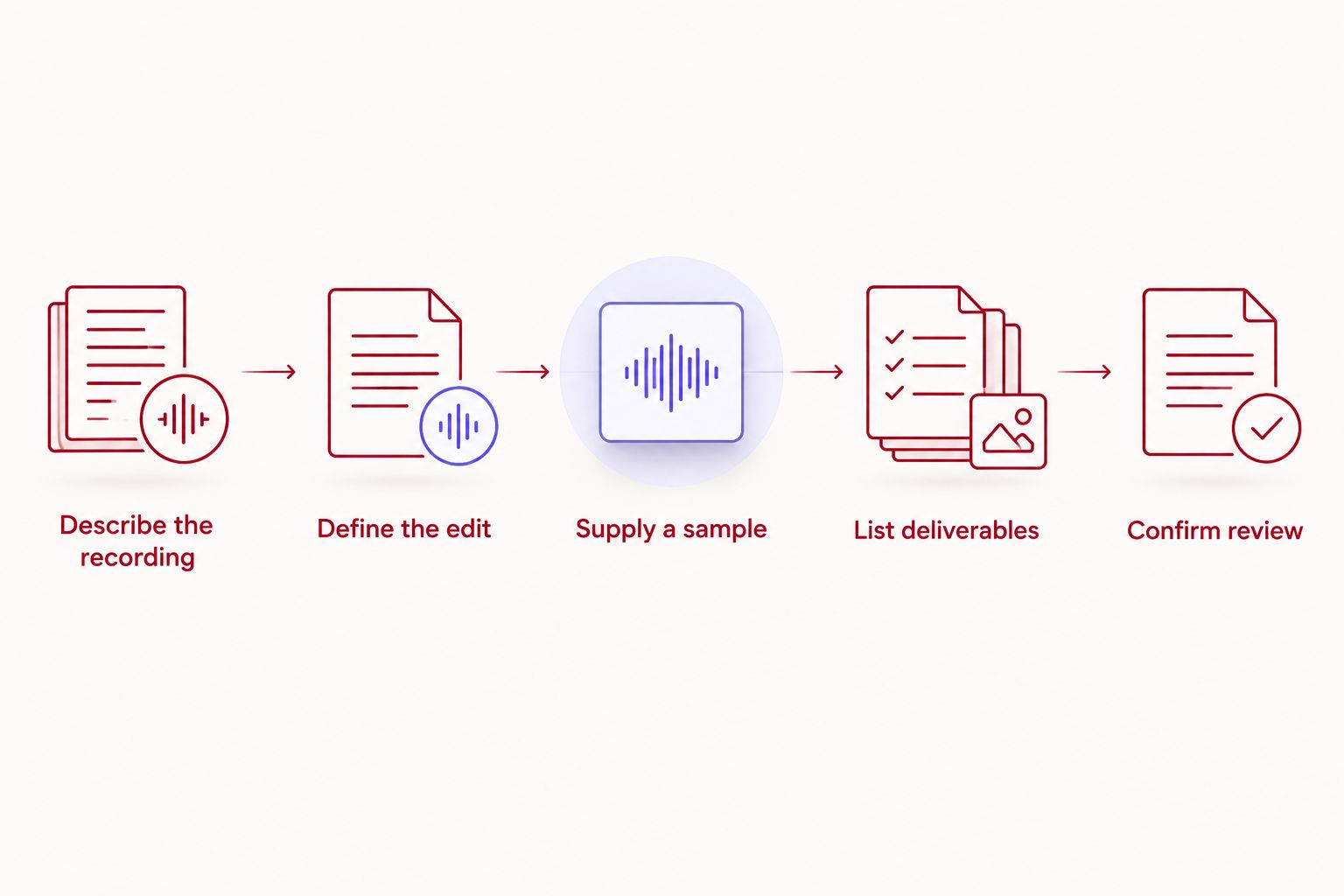
For a recurring show, request a quote for 1 representative episode before defining an ongoing scope. This is a recommended planning step, not a claim about a provider's minimum booking or package terms.
Keep the request specific. Instead of asking for professional sound, describe the outcome: balanced voices, removal of identified mistakes, an approved introduction, and a finished file for your publishing destination.
What should your editing brief include?
Your 2026 editing brief should let someone work without guessing what you mean. Use short instructions and distinguish required changes from preferences.
Content instructions
Mark sections that must be removed and passages that must remain. Flag names, technical terms, sensitive statements, and any material awaiting approval. If a guest corrects an answer later in the recording, identify which answer to use.
Sound instructions
Describe the problem you hear rather than prescribing a technical fix. For example, identify a distracting hum or a speaker who becomes difficult to hear. Let the editor assess the appropriate treatment.
Delivery instructions
Name the destination and required file format. If another editor will handle video, say which files that person needs. Do not assume a finished listening file and an editable production handoff are interchangeable.
Review instructions
Choose 1 consolidated revision list for each review round. Collect internal feedback before sending it to the editor, and distinguish corrections from new creative requests. This gives everyone a clear record of what changed.
Does recording in a studio replace audio post-production?
Studio recording and post-production solve different problems. Recording captures the performance. Post-production changes, balances, and prepares that performance for delivery.
Justpushrecord's podcast recording studios use 3 cameras and 1 button, with files delivered through Google Drive without a crew. That workflow suits hosts who want to record without managing a production team. It does not establish that content editing, audio repair, video editing, or publishing is included.
The practical advantage is a defined recording workflow. The boundary is the work after recording: assign an owner for reviewing footage, editing the episode, approving changes, and publishing the final files.
Before booking, confirm what you receive and how your editor will use it. Ask about the delivered file structure and any specific handoff requirements rather than assuming the recording matches an existing editing workflow.
Is an hourly quote better than a per-episode quote?
Neither quote format is better without a defined scope. An hourly arrangement needs clear approval rules for additional work. A per-episode arrangement needs clear limits on what counts as that episode.
| Quote format | Best for | Advantage | Limitation to resolve |
|---|---|---|---|
| Hourly work | Projects whose required repairs need assessment | Work can be described by the time spent | Ask for an estimate and an approval checkpoint |
| Per-episode work | Repeatable episodes with a consistent brief | The deliverable can be defined before work begins | Confirm source-length, revision, and output boundaries |
| Defined project | A specific batch or production assignment | Several deliverables can share one written scope | Confirm what happens when requirements change |
Ask how the provider handles work outside the agreement. A clear change process matters more than the label on the proposal.
Can you reduce editing work before recording?
Yes. Prepare the conversation and catch recording problems before you commit the full session. Editing is not a substitute for an understandable performance.
Give the host an outline, confirm names and key facts, and identify material that needs precise wording. During recording, let a speaker finish before responding. If an answer goes wrong, pause and restart the complete thought so the editor has a clear replacement.
Record and listen to a short test before the main conversation. Check that every speaker is intelligible. These steps address the source recording rather than asking an editor to solve every problem afterward.
FAQ
How do I compare audio post-production quotes in Austin in 2026?
Compare quotes against the same recording and written scope. Confirm dialogue editing, cleanup, mixing, revisions, and final outputs before comparing totals.
Does a podcast studio booking include editing?
A studio booking does not establish that editing is included. Check the written booking details for recording files, editing services, revisions, and publishing responsibilities.
Should I pay hourly or per episode for podcast editing?
Choose the format that gives you a clear scope and approval process. Hourly work needs an estimate and checkpoints; per-episode work needs defined recording, revision, and delivery boundaries.
Can an audio editor fix every recording problem?
No. An editor cannot recreate speech that was not captured clearly. Send a representative sample and ask which problems can be addressed before approving repair work.
Does audio post-production include video editing?
Only when video editing appears in the agreed scope. List the full episode video, audio version, clips, and other exports separately so responsibilities are clear.
What should I send an editor before requesting a quote?
Send the recording details, a representative sample, content instructions, and required deliverables. Include your review process and any approved music, introductions, or closing messages.
Is a one-button studio suitable if I already have an editor?
A one-button recording workflow suits hosts who want to record without managing a crew. Confirm the delivered files meet your editor's requirements before booking.
One last thing
Write the delivery checklist before you request the quote. A project is not finished merely because you can play the exported audio. It is finished when the approved content and required files reach the person responsible for publishing.
For your next Austin recording in 2026, assign those responsibilities before the session. Decide who approves cuts, who collects feedback, and who checks the final export. A clear handoff keeps recording, editing, and publishing from becoming separate unfinished tasks.